
The SaaSpocalypse: Why Software Is not Dying, It is Just Evolving
Why some SaaS will thrive while others die

The headlines of February 2026 have been nothing short of breath-taking. In a single week of trading, nearly $300B in market value evaporated from the software sector. To the casual observer, it looks like the end of an era. To the Quality investor, it looks like a Great Sorting (and a return to a more normal state)
The narrative driving this sell-off is simple: If AI can write code, automate workflows and replace human seats, then the $600B SaaS industry is a house of cards. But this view misses the nuance of evolution. While thin-wrapper apps and horizontal tools are indeed facing an existential threat, a new class of software is emerging. We are not witnessing the death of software, we are witnessing the death of the un-integrated, seat-based business model. The moats are not disappearing, they are moving.
The SaaSpocalypse
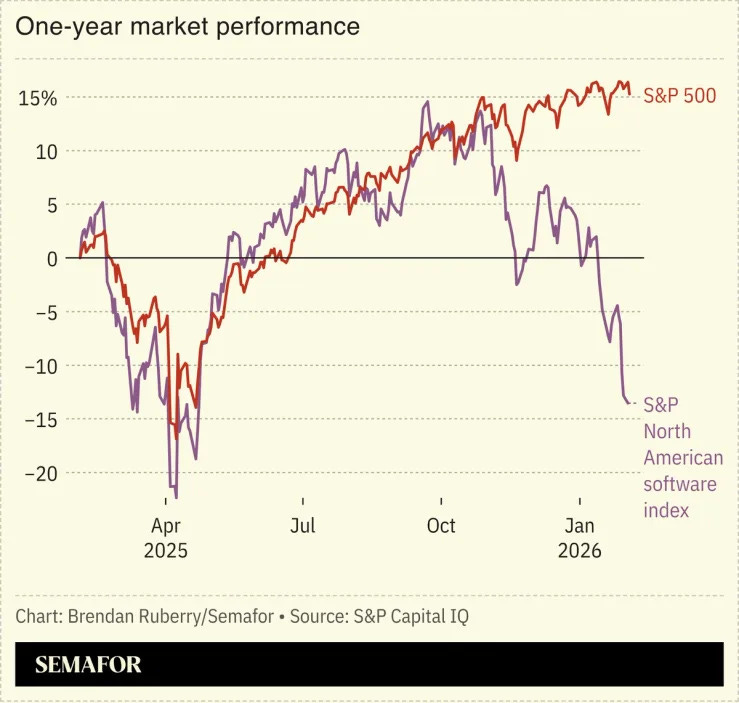
The "SaaSpocalypse" of has been defined by a brutal market. We saw this play out in real-time with a lot of software like Dassault Systemes, which suffered its worst trading day in history on February 11th, with shares plunging over 20% following their Q4 release. Despite a stable operating margin of 37%, the market balked at a mere 1% revenue growth and a 2026 guidance that felt like a relic of the pre-AI era.
In this environment, investors are ruthlessly repricing any incumbent that has not yet proven it can turn AI agents into a meaningful top-line driver, proving that the old "subscription stability" moat is being breached.
What does the market fear?
For years, the software-as-a-service model thrived on a simple, linear relationship where revenue grew in tandem with customer headcount (per-seat). However, the sudden proliferation of agentic AI tools like Claude Cowork has effectively decoupled software from labor. When a single AI agent can autonomously navigate a CRM, log support tickets and generate compliance reports, the need for dozens of human licenses evaporates. This seat compression turned the sector’s most reliable growth engine into a liability overnight, as investors realized that the more efficient a software’s AI becomes, the fewer paid users it actually requires.
Beyond the shrinking user base, the sell-off reflects a growing fear that traditional software moats are being dismantled by vibe coding and AI-native competition. In this new regime, the barrier to entry for complex software has dropped significantly that internal IT teams and small startups can recreate specialized tools in a fraction of the time it once took. This has led to a ruthless prioritization within enterprise budgets. To fund massive investments in AI infrastructure and chips, companies are auditing their SaaS portfolios and cutting soft ROI tools that offer simple productivity gains.
Which software will survive?
The software that find themselves in the most immediate danger are those whose primary value is serving as a visual interface for human coordination. Platforms like Monday are particularly vulnerable because they are often utilized as horizontal project management tools where revenue is strictly tied to the number of people logging in to update statuses. Additionally, the level of integration is very low.
In a world where AI agents can autonomously track progress and sync data across teams, the need for dozens of individual human seats for simple check-in work evaporates. This is reflected in the market’s nervous reaction to companies that still rely on per-seat pricing for basic collaboration, as these tools risk becoming ghost towns where the work is happening via background automation rather than active human engagement. This same risk extends to basic point solutions in marketing or customer support that offer productivity gains for humans but fail to capture the value of the actual work being performed by AI.
In contrast, the software companies that will thre during this transition are those that have repositioned themselves as the essential execution layer for the agentic era.
ServiceNow serves as a prime example of a survivor: it has effectively moved from being a ticketing interface to a system of action where its workflows are deeply integrated into the core IT and HR plumbing of an enterprise. Because an AI agent requires these structured workflows and data permissions to execute a task (like onboarding an employee or resolving a server crash) ServiceNow becomes more valuable as automation increases, regardless of how many humans are involved.
Similarly, Salesforce has aggressively pivoted toward outcome-based monetization through its Agentforce platform, which charges per conversation or action rather than just per user. By decoupling their revenue from headcount and anchoring it to the successful completion of work.
To identify the software survivors in your portfolio, look for these characteristics:
System of record dominance. The software acts as the single source of truth for proprietary enterprise data (like financial ledgers, clinical records or supply chain physics) that AI agents require to function accurately. Examples: SAP, ServiceNow or Manhattan Associates
Outcome-based monetization. The business model has successfully decoupled from human headcount, instead charging based on the value or work completed by AI agents Examples: Salesforce
High architectural gravity. The platform is so deeply integrated into the company’s mission-critical workflows and regulatory compliance stacks that the cost and risk of ripping and replacing it are prohibitively high. For those outside the industrial sector, it is difficult to grasp the sheer gravity of an enterprise deployment. Unlike a simple SaaS subscription, integrating a PLM or ERP system is a multi-year digital heart transplant where the technical complexity and implementation costs create a moat that AI cannot simply bypass. Examples: SAP or Dassault Systemes
Agentic interoperability. The software offers robust, high-velocity APIs that allow autonomous agents to not just read data, but to execute complex write actions back into the system of record. Example: ServiceNow
Vertical specialization. The product solves highly complex, industry-specific problems (like specialized engineering simulation or legal discovery) where generic LLMs lack the necessary precision and domain-specific guardrails. Examples: RELX or Dassault Systemes
3 Examples
1. ServiceNow
ServiceNow is the ultimate System of Action. While the market fears AI will replace human help desks, it ignores that an AI agent still needs a structured environment to execute tasks. ServiceNow provides the plumbing for the enterprise. Its high-velocity APIs allow autonomous agents to not just identify a problem, but to write the fix directly into the IT record. By moving toward a model where they charge for the value of the automated resolution rather than the number of agents sitting in a call center, they are turning "seat compression" into a margin expansion story.
System of record 🟢
Outcome-based monetization 🟠 (emerging)
High architectural gravity 🟢
Agentic interoperability 🟢
Vertical specialization 🔴 (or partial with IT, Supply Chain or Finance)
2. SAP
SAP represents the Digital Heart of the global economy. As the primary system of record for finance and ERP, it holds the proprietary data that a corporate AI needs to be accurate. You cannot have an AI agent manage a supply chain if it does not have access to the real-time ledger and inventory data that lives inside SAP. Because these deployments are digital heart transplants with high architectural gravity, the risk of an AI startup replacing SAP is virtually zero. The AI will simply become a new interface for the SAP engine.
System of record 🟢 (transactions and finance at least)
Outcome-based monetization 🟠 (emerging)
High architectural gravity 🟢 (the heart)
Agentic interoperability 🟠
Vertical specialization 🔴
3. Dassault Systemes
Dassault is the definition of Vertical Specialization. Their PLM (Product Lifecycle Management) tools manage the physics and engineering of ultra-complex products like aircraft and surgical equipment. This is not word processing, it is high-precision simulation. Their moat is built on decades of deeply integrated engineering IP and a technicity that creates massive switching costs.
System of record 🟢 (product)
Outcome-based monetization 🟠 (emerging)
High architectural gravity 🟢
Agentic interoperability 🟠
Vertical specialization 🟢
Conclusion
Panic is rarely a profitable strategy. While SaaSpocalypse headlines focus on the loss of seat-based revenue, they ignore the birth of a new industry. When technology makes a task easier, the volume of that work explodes. The Agentic Fortresses controlling the System of Record will capture this volume, transitioning from human tools into autonomous engines.
These companies are not static, they are reinventing themselves. NVidia CEO Jensen Huang addressed this market anxiety in February 2026, calling the fear that AI would replace software “the most illogical thing in the world”. He argued that even the most advanced AI will choose to use a proven tool rather than reinventing it:
“There’s this notion that the tool in the software industry is in decline and will be replaced by AI. It is the most illogical thing in the world... If you were a human or robot... would you use tools or reinvent tools? The answer, obviously, is to use tools.”
For the patient investor, this anxiety is a gift: a chance to acquire mission-critical infrastructure like Dassault Systèmes or SAP at a discount. These platforms are currently challenged but they are not yet disrupted. By pivoting toward outcome-based pricing and becoming the execution layer for AI, they are securing the next decade of growth.
As always, caution is key. if you like this sector, don't blow your capital on one entry, scale in and stay diversified to weather the volatility.
I have scored 21 industry leaders using the Quality Stocks Investment Framework to find the best opportunities in the current sell-off

the latest dassault systemes earnings call is sobering - this is a powerful company in the midst of slow growth, some strategic challenges and structural transitions. in other words, the share price has solid reason to decline in my view - not a NOW or SAP whose shares have been hammered independently of company specific reasons. we'll see if CRM sees eroded growth from AI or not. my inclination is that CRM proves to be a value trap over time as large enterprises work directly with LLMs and IT consultants to replicate enough of its offering - and as an alternative to using CRM's agents, to keep CRM in the 'value' category. Punch line for me, right or wrong: NOW and SAP are attractive, although both can still go lower in the shorter term, while DS requires a fresh look later this year and CRM is an avoid. Also, let's say CRM posts earnings that are better than the gloom: the shares 'pop'. I'd expect them to give up gains over the following days / weeks as investors return to awaiting AI's feared negative impact.
Thanks for writing this and explaining. I guess my concern is still white collar job losses. If tech jobs slowly diminish while margins expand, is that really healthy for the entire SaaS space even if these companies transition from per-seat pricing to outcome-pricing.