
Badger Meter Stock Analysis: Quality But Not At The Right Price
An elite compounder but true investors should wait for a deeper discount

Welcome to “Stock Analysis”, a new series where we go beyond headlines to understand how businesses really make money. The series focuses on introducing new investment ideas by highlighting often less-followed companies. Each article applies the Quality Stocks Investment Framework to assess business quality, return potential and identify buy zones, providing readers with the tools and context needed to form their own investment decisions.
For paid subscribers, each Stock Analysis goes a step further by opening up the full reasoning behind the investment thesis and decision process:
Detailed TSR calculations, including all underlying assumptions. This allows investors to understand what must go right for the investment to deliver acceptable returns and to stress-test their own expectations against explicit inputs
Explicit bull and bear cases. It helps frame both upside potential and downside risks, making uncertainties visible rather than implicit and supporting more balanced, risk-aware decisions
My analysis beyond the overall verdict. This provides a deeper insight, enabling investors to form an independent view rather than relying solely on a conclusion
For this 10th episode, it is time to analyze Badger Meter. For anyone tracking the global water utility space, Badger Meter is a familiar name. On paper, the business model offers an exceptionally high-quality setup: elite capital efficiency, robust operating profitability and an increasingly sticky recurring revenue base driven by strategic software acquisitions. While long-term municipal infrastructure modernization provides an undeniable secular tailwind, near-term performance remains tightly bound to uneven project deployment cycles. With the market demanding a premium multiple, the central question for investors is clear: does the long-term software transition justify paying up for short-cycle infrastructure exposure? Let’s deconstruct the business model and find out.
Previous stock analyses


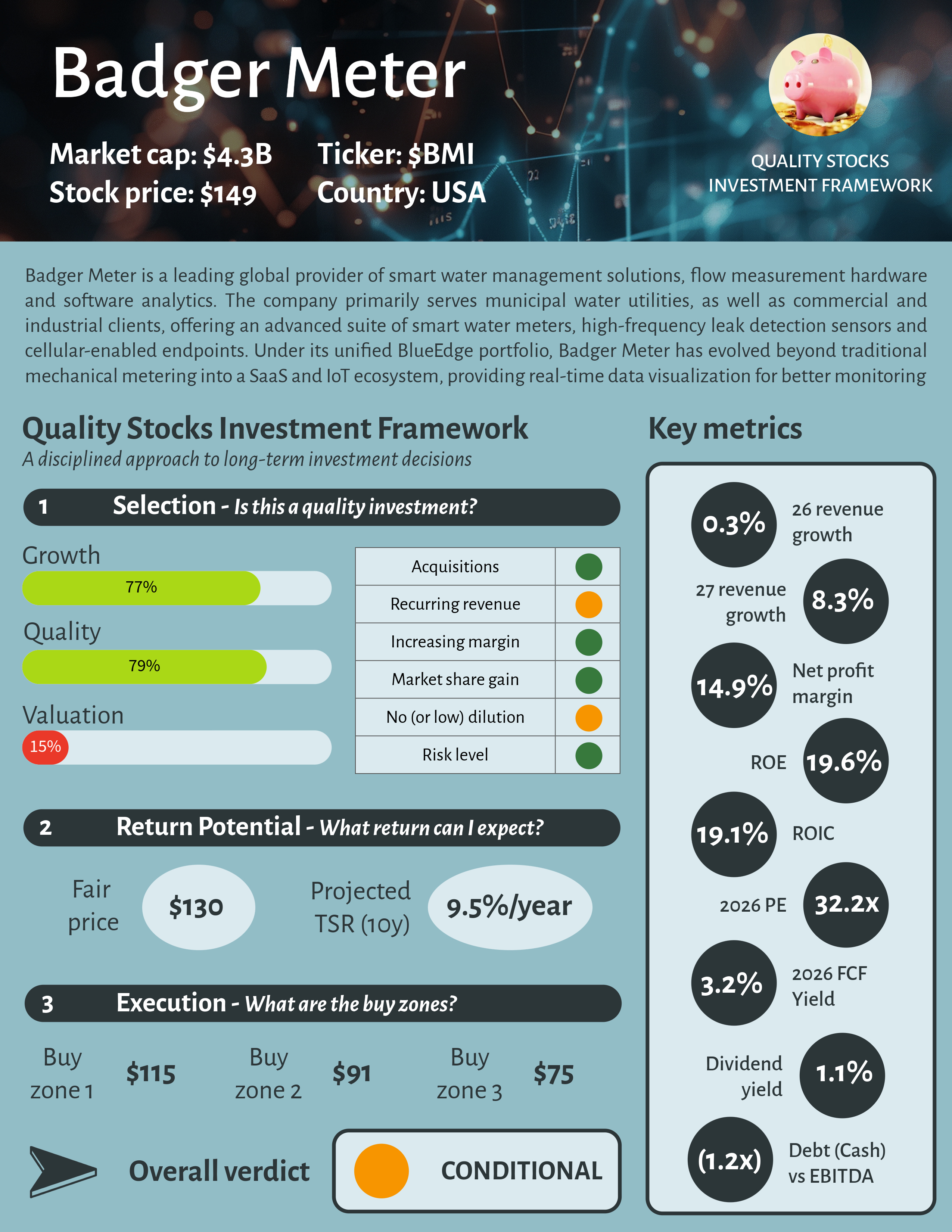
One Pager
The stock at a glance
The business model of Badger Meter
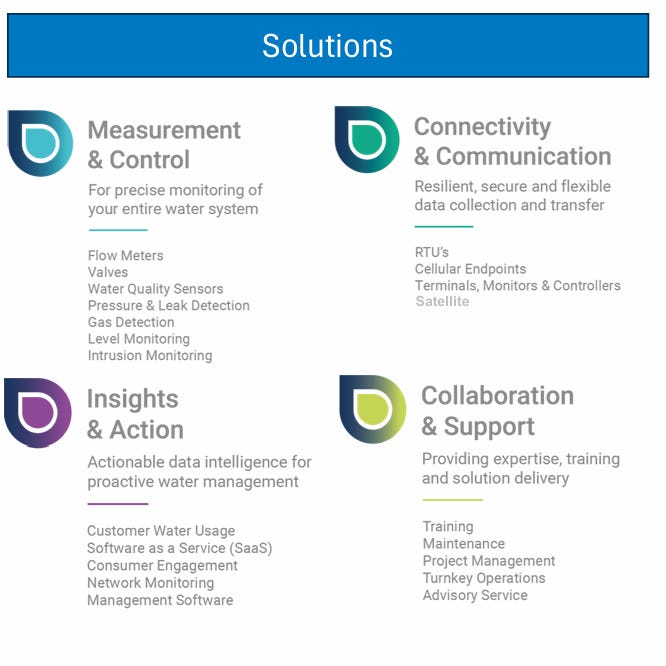
Badger Meter has successfully transitioned from a legacy industrial manufacturer into a high-tech Internet of Things (IoT) and Software-as-a-Service (SaaS) player centered on water management. Under its comprehensive BlueEdge framework, the company’s product ecosystem spans the entire utility and industrial water cycle.
The foundation of the business relies on Measurement and Control, featuring advanced physical hardware like ultrasonic meters, mechanical flow meters, valves and water quality sensors. To make this hardware “smart,” the company layers on Connectivity and Communication tools, embedding cellular endpoints (such as their ORION radios) directly onto the meters to securely transmit real-time data. This data feeds directly into their high-margin Insights and Action division, which is powered by their proprietary BEACON SaaS platform. This software translates raw water usage into actionable alerts for leak detection, pressure monitoring and consumer billing optimization. Finally, they provide Collaboration and Support through training, project management and advisory workflows to entrench themselves within long-term utility planning.
The company’s primary target market consists of Municipal Water Utilities and Water Districts, which are highly defensive, recession-insulated entities responsible for public drinking water distribution and billing. These customers are currently being forced to modernize due to deep secular tailwinds, including severe workforce churn, water scarcity and the urgent need to mitigate Non-Revenue Water (water lost to undetected leaks before it can be billed).
Badger Meter also captures a smaller but highly profitable secondary segment in Commercial and Industrial (C&I) Clients. These customers span chemical processors, manufacturing facilities and HVAC operators who rely on precision flow instrumentation and specialized gas detection systems to ensure strict regulatory compliance, prevent costly industrial downtime and maintain resource efficiency.
A serial acquirer
While organic adoption of cellular smart meters forms the bedrock of Badger Meter’s growth, the company has quietly built an exceptional track record as a disciplined, programmatic serial acquirer. Management does not engage in large, dilutive, ego-driven acquisitions. Instead, they use a pristine, debt-free balance sheet and reliable free cash flow to execute strategic, bite-sized tuck-in acquisitions that expand their BlueEdge software capabilities. By targeting niche hardware-enabled software providers operating in adjacent areas of the water cycle, Badger Meter systematically absorbs smaller competitors and plugs them straight into their massive municipal distribution network.
This strategy took shape with the January 2025 acquisition of SmartCover Systems, which handed Badger Meter a dominant foothold in continuous, 24/7 North American sewer line and lift station analytics. Doubling down on this high-conviction thesis, the company deployed $100M in cash in April 2026 to buy United Kingdom-based UDlive Limited, a premier developer of low-power water-level sensors and cloud visualization analytics boasting a $22M revenue profile.
Short-term challenges
Badger Meter’s Q1 26 earnings report sent shockwaves through the market, triggering a massive single-day stock collapse of over 20% after failing to meet lofty growth expectations. The company reported diluted EPS of $0.93, missing the consensus Wall Street estimate of $1.20 by more than 22%. Top-line performance similarly underperformed: quarterly revenue contracted 9% YoY to $202M, falling short of the $230M analyst consensus. This sudden reversal marked a stark departure from the company’s multi-year streak of relentless, premium-multiple growth, forcing a harsh recalibration of the stock’s valuation.
The fundamental disappointment traced back to a combination of project pacing dynamics and a sudden, unexpected freeze in short-cycle municipal budgets. Management revealed that utility water sales fell 10% because several major, multi-year smart meter installation projects had wound down, leaving a temporary gap before the next wave of awarded projects launches in the second half of the year. Making matters worse, short-cycle ordering patterns, where the company historically enjoyed steady, high-margin transactional flow, stalled unexpectedly, draining an estimated $15M to $20M from internal revenue expectations. Because Badger Meter’s underlying operating costs remained sticky (further weighed down by integration costs from recent acquisitions like SmartCover) this drop in revenue triggered severe negative operating leverage, compressing operating profit margins from 22.2% down to 17.4%.
What truly spooked long-term growth investors, however, was management’s revised outlook for the rest of the year. While the executive team reiterated that underlying structural demand and their competitive moat remain completely intact, they were forced to walk back their full-year guidance, anticipating that organic revenue for the full year 2026 will finish relatively flat compared to 2025. For a stock that had been trading at a luxury multiple bordering on 40x PE, a sudden pivot from double-digit compounding to flat growth proved that even the highest-quality defensive moats are not immune to execution gravity when priced for perfection.
Long-term outlook
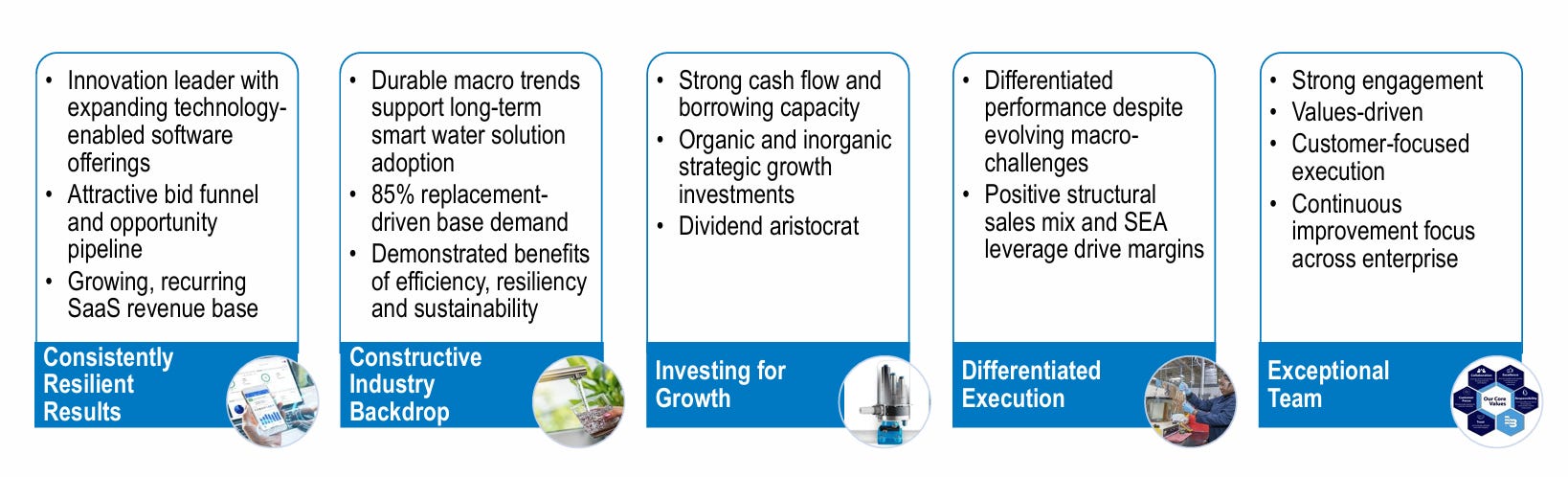
Despite near-term project pacing friction and a flattening 2026 growth profile, Badger Meter’s structural, multi-decade bull case remains fundamentally intact. The company sits at the convergence of powerful, non-discretionary secular tailwinds: global water scarcity, crumbling municipal infrastructure and escalating regulatory standards regarding wastewater and overflow management.
By systematically embedding high-margin SaaS analytics like BEACON and SmartCover into its cellular hardware footprint, Badger Meter is successfully transitioning from a transactional hardware supplier into a recurring revenue machine. Furthermore, its pristine, completely debt-free balance sheet ensures it can comfortably weather near-term macro volatility while continuing to aggressively pursue its compounding programmatic M&A framework.
To go beyond the initial analysis, paid subscribers unlock the detailed TSR calculation with underlying assumptions, explicit bull and bear cases and my full analysis beyond the verdict, providing deeper insight into risks, opportunities and the investment decision process
Detailed TSR calculation
The projected Total Shareholder Return (TSR) is built from 6 components, each estimated on an annualized basis:
Organic growth: +7.0%/year. The infrastructure renewal needs will be a strong tailwind in the coming years
Acquisitions: +2.5%/year. Acquisitions will continue at a good pace as the balance sheet remains very healthy (about $200M net cash position)
Dividends: +1.0%/year. This assumes a continuation of the current dividend policy
Share dilution: +0.0%/year. For now cash is mainly used for dividends and M&A
Valuation contraction: -2.8%/year. I expect valuation to continue its normalization. Despite an increasing proportion of recurring revenue the activity remain cyclical
Margin expansion: +1.8%/year. Margin should continue to improve as the company scales
Total: 9.5%/year
Bull Case
Capital efficiency. Operating a high-margin, hardware-enabled SaaS model allows Badger Meter to turn incremental infrastructure spend into consistent profitability, historically maintaining a robust gross margin profile and a strong ROE / ROIC.
Software mix shift. The continuous organic scaling of its BEACON software alongside strategic integrations like SmartCover enables the company to steadily expand its high-margin recurring SaaS activity
Wastewater and sensing expansion. By aggressively acquiring complementary technologies like SmartCover and UDlive, the company has expanded its total addressable market beyond traditional clean water meters into continuous, real-time sewer and stormwater network analytics
Strong balance sheet. The business is a consistent free cash generator, preserving an entirely debt-free balance sheet with over $200M in cash and cash equivalents. This financial cushion comfortably funds their programmatic M&A
Secular tailwinds. Driven by workforce shortages, climate-induced severe weather volatility and the critical municipal need to curb non-revenue water loss, long-term capital allocations toward smart digital water infrastructure provide an exceptionally durable, defensive multi-year runway
Geographical expansion. For now, most of the revenue is in the US leaving room for expansion into international markets
Bear Case
Near-term revenue flattening. Following a sharp cyclical deceleration, management’s revised outlook expects FY 2026 organic revenue to be relatively flat compared to 2025, halting a multi-year narrative of rapid top-line compounding
Cyclical activity. A meaningful portion of Badger Meter’s traditional flow instrumentation and transactional billing business remains exposed to volatile, short-cycle municipal budgets that can abruptly freeze up and miss internal baseline expectations
Luxury valuation. Even after significant stock pullbacks from historical highs, trading at a premium valuation multiple above 30x forward earnings leaves virtually zero room for execution errors, regulatory shifts, or supply chain bottlenecks
Competition risk. Competition is always a risk especially for a company relatively small as Badger Meter (less than $1B revenue)
My analysis
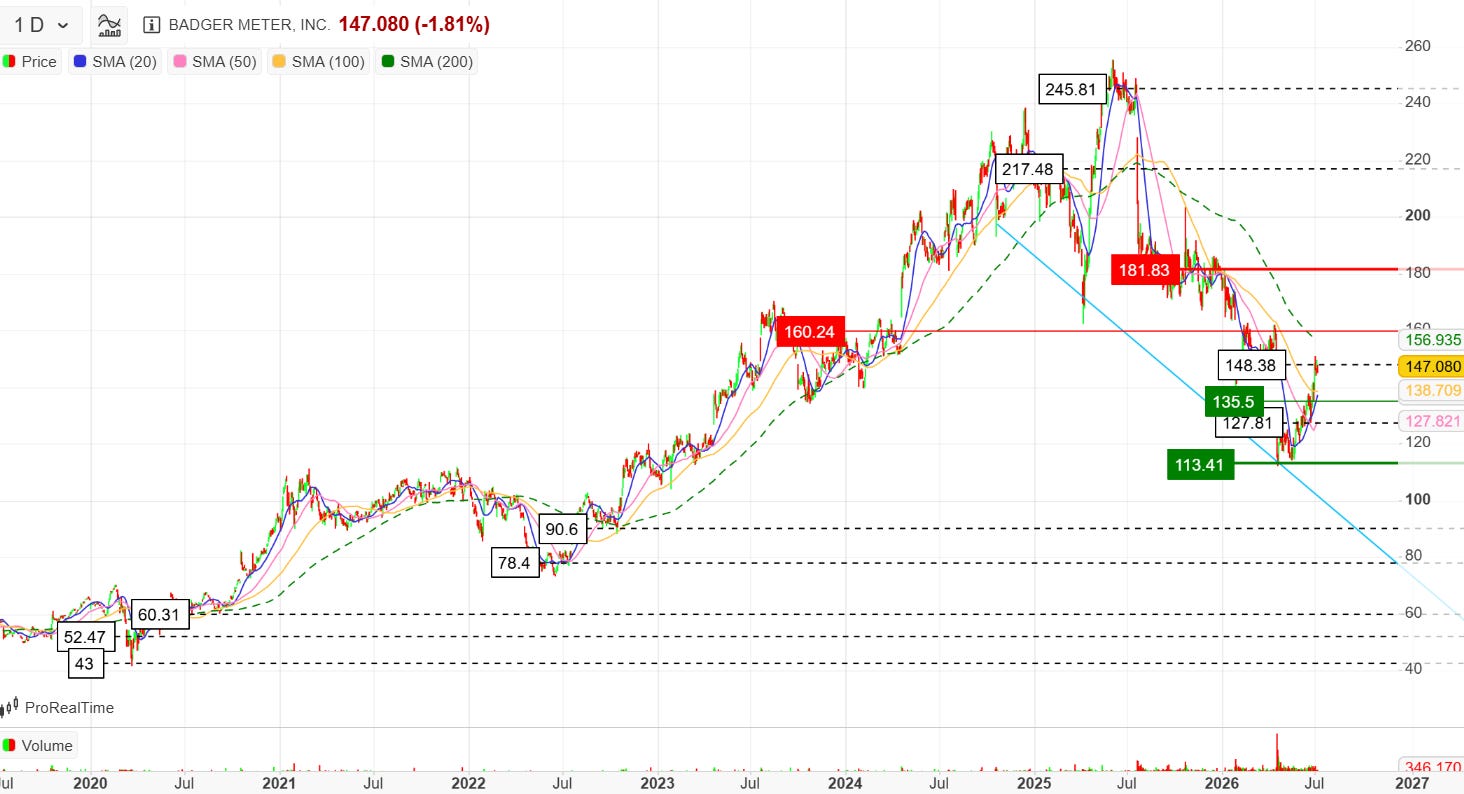
While the recent market pullback may look severe on a chart, Badger Meter's valuation remains fundamentally elevated. There is no question that the company represents a world-class franchise: management’s disciplined programmatic M&A strategy, robust margin profile and steady structural mix shift toward high-margin recurring SaaS revenue are highly commendable. Backed by extensive infrastructure tailwinds in both North America and key international markets, a pristine, debt-free balance sheet gives them immense strategic optionality.
We initially initiated a small tracking position to monitor the equity, intending to add on a deeper correction. However, even after the drawdown, the stock bounced back and the multiple of nearly 30x forward earnings does not offer an adequate margin of safety for a business that remains inherently bound to cyclical municipal budgets. For investors not yet positioned, the most prudent move is to wait for a better entry point that offers a more compelling risk-reward skew.