

The public market debut of SpaceX will go down as a defining moment in financial history. Emerging onto the public stage with an initial market capitalization of $1.77T, the stock has since defied gravity, surging to $2.5T even it lost most of its gains. To put that into perspective, the market at its top was valuing Elon Musk’s aerospace giant on par with global tech titans like Microsoft.
The enthusiasm went into overdrive following SpaceX’s jaw-dropping, $60B all-stock acquisition of AI coding platform Cursor. It was a move that signaled to Wall Street that SpaceX is not just a rocket company, it is being priced as a sprawling, vertically integrated monopoly dominating space logistics, global telecommunications and next-generation AI infrastructure.
The potential Total Addressable Market: $28.5 Trillion
SpaceX outlines its Total Addressable Market across 3 core verticals. Crucially, these figures completely exclude Russia and China, making them focused entirely on accessible global markets:
The Space Segment (Launch & Logistics): $370B
Ironically, the division that made SpaceX famous (rocket launches and Starship) represents a mere 1% of their claimed long-term market opportunity.
The Connectivity Segment (Starlink Broadband & Mobile): $1.6T
This is broken down into roughly $870B for Starlink Fixed Broadband and $740B for Starlink Mobile
The Artificial Intelligence Segment (Orbital Compute & Enterprise Software): $26.5T
This is the jaw-dropping kicker that makes up over 93% of SpaceX’s entire TAM. It includes $2.4T for AI infrastructure (like their plan to launch 1 million satellites to serve as orbital data centers), $760B in consumer AI subscriptions, and a massive $22.7T for Enterprise AI applications (leveraging their xAI integration and acquisitions like Cursor)
The FY25 revenue was $18.7B, FY26 should be between $23B and $35B. FY30 forecast is $300B (according to analysts) and $1T (according to Musk) representing a CAGR between 74% and 121%.
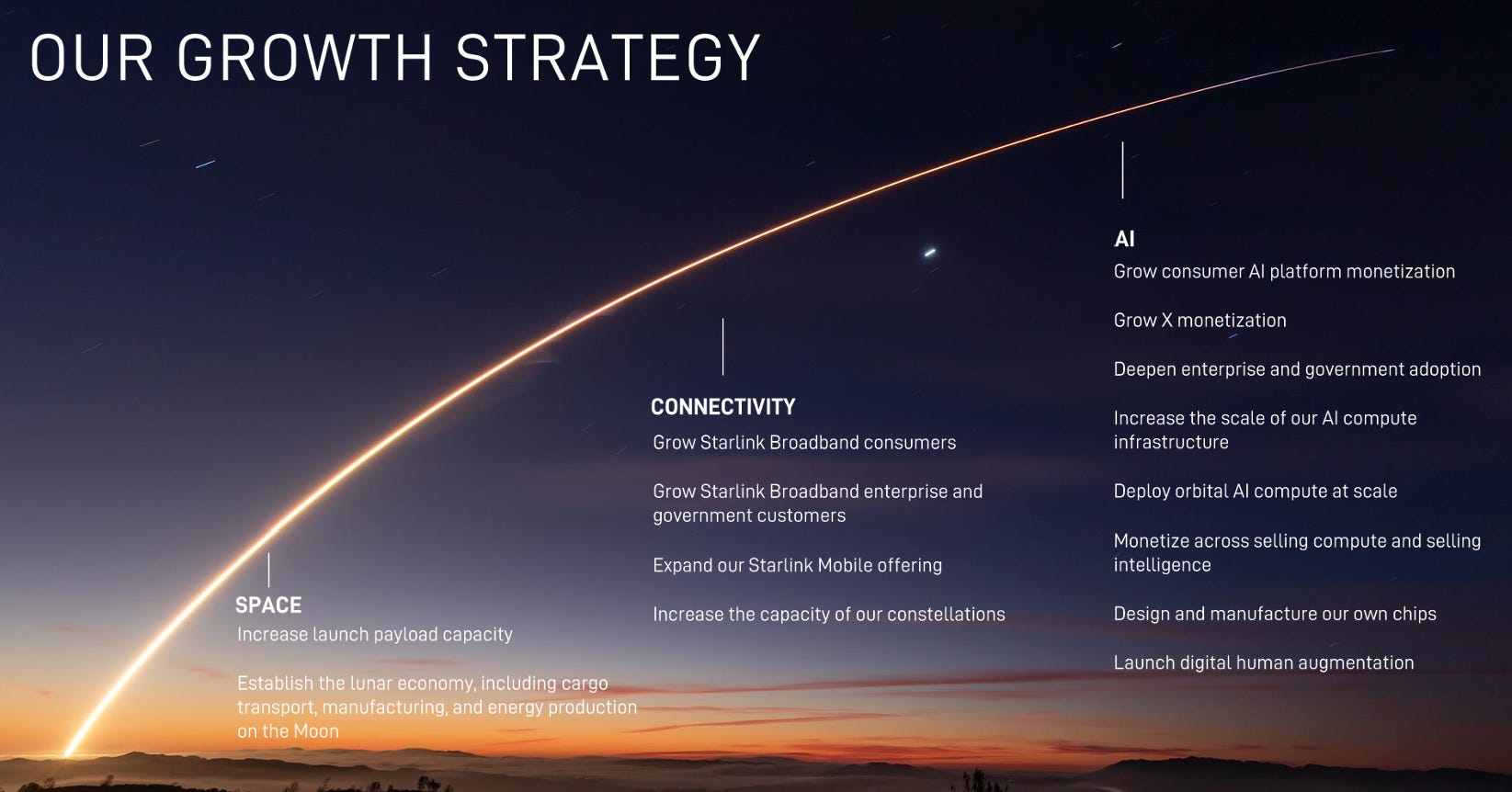
The current segment revenue breakdown is as follows
Connectivity (Starlink): $11.4B (61% of total revenue). This is the only consistently profitable segment today, bringing in $4.4B in operating profit and crossing 10 million active global subscribers
Space (Launch): $4.1B. While they completed a record 165 Falcon 9 launches in 2025, only 43 were for outside commercial/government clients, nearly three-quarters were used internally to deploy Starlink. This segment posted a $657M operating loss due to massive Starship development costs
AI Segment: $3.2B. Despite the revenue, it dragged down the bottom line with a $6.4B operating loss, fueled by a staggering $12.7B in AI capital expenditures as they build out ground and orbital compute capacity
The ultimate promise SpaceX is selling is not about sending rockets to Mars, it is about solving the biggest bottleneck in the AI revolution: power and logistics on Earth. By pitching space-based AI data centers powered by 24/7 uninhibited solar energy, SpaceX is positioning itself to bypass terrestrial power grid constraints. Wall Street bulls, like Dan Ives at Wedbush, argue that investors are not buying a capital-intensive hardware company, they are buying a vertically integrated AI and data infrastructure monopoly that happens to operate in orbit.
The foundation: a masterclass in industrial cost destruction
Before analyzing the astronomical valuation or the AI master plan, we must first look at the bedrock upon which SpaceX is built. The only reason public markets are willing to entertain a multi-trillion-dollar cap for this business is because Elon Musk did something the entire global aerospace establishment claimed was physically and economically impossible: they commoditized space.
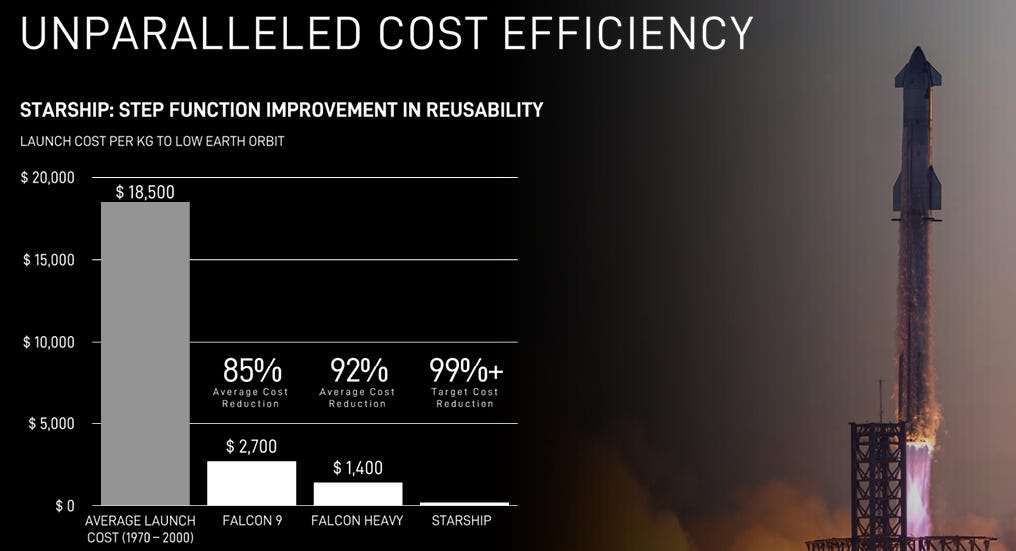
For over half a century, the space industry operated on an incredibly inefficient, legacy defense-contractor model. Rockets were treated like expendable, single-use ammunition, gorgeously engineered, hundred-million-dollar pieces of hardware that were thrown into the ocean after a single flight. SpaceX shattered that paradigm through a relentless focus on two structural pillars: vertical integration and rapid reusability.
A large conglomerate
The structural transformation detailed in SpaceX’s S-1 filing makes it clear that the entity trading on public markets is no longer just a rocket company. Instead, it is a massive industrial and technological conglomerate holding 3 wildly distinct businesses under one corporate umbrella. Each of these segments operates with entirely separate margins, capital expenditure requirements and competitive landscapes.
The first pillar is the foundational Launch division, which acts as the asset-heavy, industrial backbone of the empire. This segment encompasses the Falcon 9 and Starship programs alongside heavy government and military launch contracts. While this division holds an absolute global monopoly over orbital logistics, its financial reality is burdened by the staggering, constant R&D costs required to make Starship a routine commercial vehicle. It represents an unparalleled, physical competitive moat, but it operates as a capital-intensive manufacturing business that acts as a low-margin foundation for the rest of the conglomerate.
The second pillar, and the primary engine of predictable cash flow, is the Starlink satellite telecommunications network. Operating essentially as a global consumer and enterprise internet utility, Starlink has scaled efficiently enough to bypass the traditional pitfalls of satellite hardware. Because it leverages the Launch division’s rockets at near-zero internal marginal cost, Starlink has managed to maintain highly profitable software-like recurring subscription revenue. It functions as the predictable, high-margin anchor of the entire organization, providing the crucial cash reserves needed to fund the conglomerate’s more speculative endeavors.
The third and most volatile pillar is the newly integrated AI infrastructure division, formed by the blockbuster merger with xAI and the subsequent acquisition of the AI coding platform Cursor. This segment operates as a hyper-growth frontier technology player, but it simultaneously serves as a massive financial black hole due to its immense computing hardware demands. Within this ecosystem sits Grok, the conversational AI tied directly to the social network X, which was also absorbed into the corporate structure. Grok exemplifies the extreme financial tension of the conglomerate. While it requires billions in capital expenditures to power its massive terrestrial supercomputer clusters, a recent slowdown in consumer engagement has forced a dramatic pivot. Rather than relying solely on individual software subscriptions, SpaceX has effectively transitioned this AI division into an enterprise infrastructure landlord, renting out its idle compute power to major tech rivals to help offset the segment’s heavy operating losses.
There is no denying it: Musk is a master of the corporate narrative.
An astronomical valuation
To truly understand the disconnect between the public market enthusiasm and fundamental reality, we have to examine the sheer scale of the mathematics currently pricing SpaceX. Pricing its historic IPO at $135 per share, the company initially debuted at a valuation of $1.77T. Within days of hitting the Nasdaq, frantic trading volume and the announcement of the $60B Cursor acquisition sent the stock into a tailspin of upward momentum, topping out at an intraday high of $225. This meteoric rise effectively propelled SpaceX past global enterprise titans like Amazon, solidifying it as the fifth-most valuable company on Earth and officially crowning Elon Musk as the world’s first trillionaire. The stock is now trading close to its IPO price around $150.
When you anchor these numbers against the financial realities disclosed in the S-1 filing, the multiples venture into unprecedented territory. SpaceX generated $18.7B in revenue for the fiscal year 2025 while recording a GAAP net loss of $4.9B. At this market cap, the trailing PS multiple sits around 100x. Even if we use Wall Street’s forward estimates for 2026, which project a doubling of revenue to $36.8B as heavy capital investments begin to yield results, the forward PS ratio remains a staggering 54x.
On the bearish end, fundamental purists like Morningstar peg the company’s fair value at a conservative $62 per share, arguing that the true sum of its launch, telecom and AI parts is worth closer to $1.2T (already very high…). On the hyper-bullish end, institutional targets reaching as high as $310 per share assume that the company’s massive infrastructure agreements (such as its cloud-compute leasing deals with Anthropic and Google) will smoothly convert into decades of highly predictable, high-margin revenue. As disciplined investors, looking at this premium requires recognizing that the market is no longer pricing a company based on its present cash flows, it is pricing an absolute leap of faith in Elon Musk's long-term corporate narrative.
To justify a $2T valuation, several extreme hypotheses must simultaneously turn into reality over the next decade:
First, SpaceX must completely capture its projected $28.5T total addressable market, requiring a suspension of disbelief that nearly all global enterprise software and AI spending will flow through orbital networks
Second, the company must maintain an absolute, permanent monopoly in both space logistics and satellite broadband, assuming that heavily funded rivals like Amazon’s Project Kuiper or sovereign state networks completely fail to dent Starlink's market share
Third, Starship must achieve immediate, flawless and routine commercial flight cadences to push launch costs below $200 per kilogram, which is the only way the capital-intensive satellite replacement cycles remain financially viable
Finally, the newly formed AI division must flawlessly monetize its compute infrastructure, meaning the multi-billion-dollar cloud-leasing deals with tech giants must scale indefinitely without facing a supply glut or a sharp correction in the broader terrestrial AI data center market
Potential risks
The Retail Mania and the Low Float Trap
A significant portion of SpaceX’s market volatility stems from its unique share structure. Because the company was private for so long and Insiders/Elon Musk retain massive, tight control over the equity, the actual public float (the number of shares available for public trading on the open market) is exceptionally low. When a massive wave of enthusiastic retail investors rushes to buy into a stock with a highly restricted supply of shares, it creates an artificial supply-and-demand squeeze. This low float acts as an accelerant, driving the price up to spectacular heights on pure momentum, but it creates a dangerous trapdoor effect: if sentiment shifts or early insiders decide to lock in profits, the lack of deep institutional liquidity means the stock could drop just as violently as it rose.
Execution Risk on an Unprecedented Scale
Even if we ignore the stock market mechanics, the physical execution required to keep this ship afloat is staggering. Starlink satellites have a lifespan of only 5 to 7 years. To maintain its network, let alone scale it, SpaceX is on a non-stop capital expenditure treadmill, they must launch thousands of new satellites every single year just to replace the ones that are dying. This entire operational loop hinges completely on Starship achieving flawless, routine and ultra-cheap commercial flight cadences. If Starship suffers any major regulatory groundings, technical design setbacks, or launchpad accidents, the financial burden of keeping Starlink alive using older, more expensive Falcon 9 rockets would severely drain the company’s cash reserves.
The Burden of an Excessive Valuation
At a trading multiple of over 130x trailing sales, SpaceX has absolutely zero margin for error. When a company is priced to perfection, the market expects flawless, exponential growth across every single business line simultaneously. Even a minor macroeconomic slowdown, a slight delay in government defense contracts or a temporary plateau in Starlink’s global subscriber growth could trigger a massive, painful repricing. Investors buying at these levels are not just paying for the company’s future success, they are paying a steep premium that assumes SpaceX will completely monopolize multiple global industries without a single operational hiccup for the next decade.
My analysis
SpaceX represents everything I find concerning in the current market: a landscape where hyper-inflated narratives completely overpower fundamental analysis. Across the broader market, there are dozens of high-conviction companies with exceptional growth runways trading at far more logical valuations, and critically, they are already highly profitable.
So, what exactly is an investor purchasing when they buy a share of SpaceX today? A path to superior compounding returns? Historically speaking, no. The risk-reward profile at these levels is heavily skewed to the downside. A piece of the future? Perhaps. A compelling narrative and the emotional high of participating in the next space race? Absolutely. The unshakeable faith that Elon Musk can magically spin gold out of thin air? Indubitably.
But this entire setup carries the unmistakable, echoing hallmarks of previous market tops: frantic retail mania, heavily unprofitable enterprises operating on pure sentiment, historic valuation multiples and extreme market concentration.
The core philosophy of this newsletter has always been about identifying resilient businesses capable of compounding capital steadily over time. But in today’s euphoric market, nobody wants to get rich slowly anymore. I remain convinced that this disciplined approach is the only way to treat the market as a long-term compounding machine, rather than a short-term casino. My ultimate hope is that the investors currently riding this wave manage to navigate the volatility safely and are not left holding the bag when the music inevitably stops.
If you like the space sector, ASTS is a much better opportunity in my opinion. ASTS is well on its way to being a giant here. I'd appreciate anyones feedback on the company also. I can never get to much data :)