

With a 150-year-plus history, Nestle is the largest food and beverage manufacturer in the world by sales. Its diverse product portfolio includes brands such as Nescafe, Perrier, Pure Life, and Purina. Nestle also owns around 20% of French cosmetics firm L'Oreal (deep dive just here). The company employs 275,000 people around the world and has a geographic presence that spans almost 190 countries.
The flat growth between 2019 and 2023 is a sign of the difficulties of the company: new customer trends, increased competition, regulation challenges, climate change, …. However the company still hasn't said its last word, and has some trump cards to play.
In this article, we describe Nestlé, its activities and the challenges it faces. We will identify outlooks, strengths and weaknesses. An analysis of the right price will provide a reference for the potential investors.
Brands and overview
Nestlé has a broad portfolio of brands divided into different divisions. Let's take a look.
Powered and liquid beverages

Revenue: CHF24.8B
Operating margin: 20.7%
Percentage of sales: 26.7%
This category features iconic coffee brands Nescafé, Nespresso and Starbucks, plus the world’s most popular chocolate malt beverage, Milo.
Petcare
Revenue: CHF18.9B
Operating margin: 20.7%
Percentage of sales: 20.3%
PetCare business delivers nutrition for pets. Purina is guided by science and driven by passion to enrich the lives of pets, the people who love them and the planet we all share.
Nutrition and health science

Revenue: CHF15.3B
Operating margin: 18.5%
Percentage of sales: 16.4%
The nutrition business provides science-based products and solutions for mothers, babies and children.
Prepared dishes and cooking aids
Revenue: CHF11.7B
Operating margin: 18.3%
Percentage of sales: 12.5%
The prepared dishes and cooking aids category provides daily essentials, including bouillons, chilled culinary products, and frozen food and pizzas.
Milk products and ice cream
Revenue: CHF11.0B
Operating margin: 24.5%
Percentage of sales: 11.8%
The milk products business delivers nutritional products for all stages of life, ambient dairy, plant-based alternatives and coffee creamers.
Confectionery
Revenue: CHF8.1B
Operating margin: 16.8%
Percentage of sales: 8.7%
The confectionery business includes the iconic KitKat brand and a portfolio of much-loved regional and local brands.
Water

Revenue: CHF3.3B
Operating margin: 10.6%
Percentage of sales: 3.6%
Division and geographical breakdown
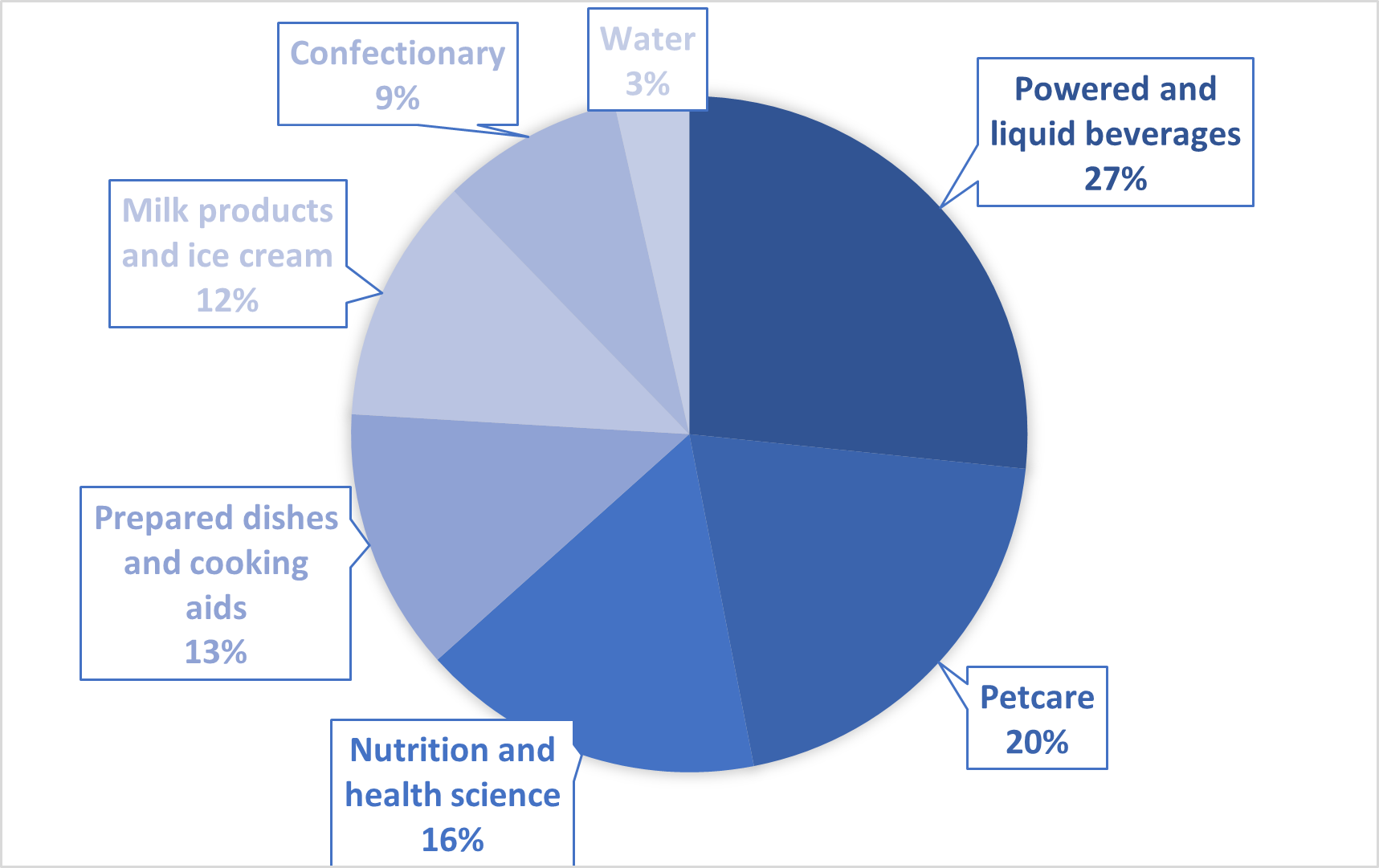
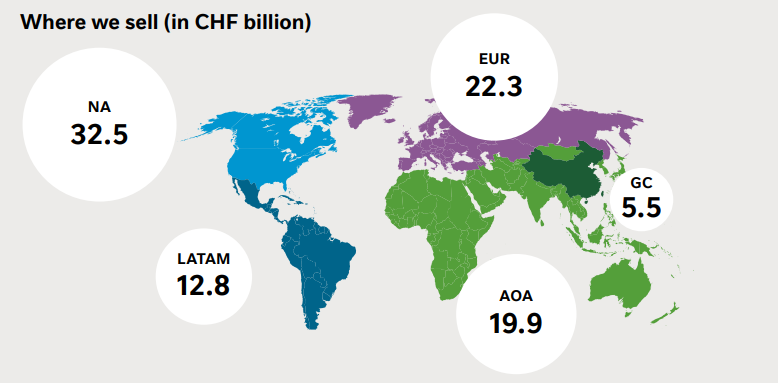
One of the strengths of Nestlé appears here: diversification. This limits the risks and smoothes out the cyclical effects that each sector or region may experience.
Growth catalysts and strategy
Nestlé defines its growth strategy by the following sentence in their Annual Report “Our purpose is unlocking the power of food to enhance quality of life for everyone, today and for generations to come. To achieve this, we pursue growth through rapid innovation, operational efficiency, and disciplined resource and capital allocation.”
In details, their strategy is dividend into different pillars:
Pushing brands able to develop strong organic growth such as early-life and therapeutic nutrition, alternative proteins, and coffee and systems technology.
Innovating across life stages and health needs, especially infant nutrition and HMO (Human milk oligosaccharides).
Expanding alternative proteins following new consumer trends: plant-based food and dairy alternatives.
Using new technologies to improve innovation processes, operations, supplier management, media and communication
Accelerating e-commerce, that should improve brand strength, links with customers and margins.
if these ambitions make sense, it is hard to see how they can significantly change the growth dynamic. They are trying to maintain their market share. To increase their moat, they spend around $2B on R&D and innovation.
Nestlé Health Science can be a strong growth catalyst on its own. 2013 - 2023 CAGR has been 11.5%. Some segment also have huge potential:
Healthy aging solutions can benefit of aging population
Weight-loss supplements for muscle mass preservation, micronutrient deficiencies, gastrointestinal health, managing weigh and blood glucose levels
L’Oreal Shares
Nestlé owns 107M shares of L’Oreal, around 20.1% of the cosmetics giants. This represents $52.8B and more than $700M dividends in 2023 only (5.5% of the net results). As a comparison total Nestlé Debt is around $59.1B.
On December 7, 2021, Nestlé agreed to sell 22.26 million L'Oréal shares to L'Oréal at 400€ per share.
Nestlé has benefited from very good returns on its investment over the long term. Moreover, Nestlé and L'Oréal have benefited from their cooperation through two successful joint ventures – Galderma and Laboratoires Innéov as well as joint efforts in research.
